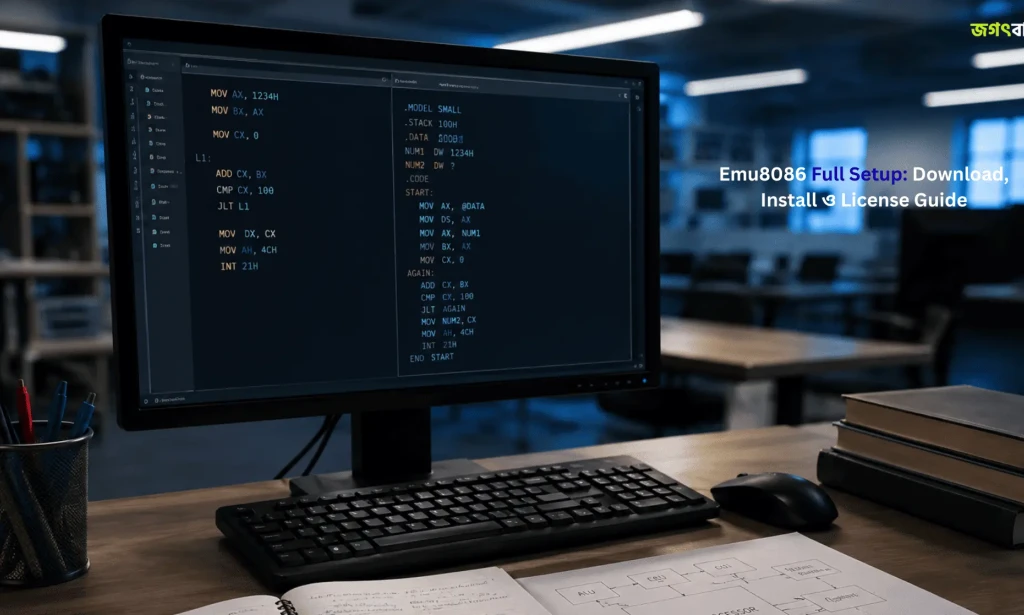
Get started with 8086 microprocessor assembly programming, register management, memory addressing, and setting up the Emu8086 emulator.
Assembly Language Programming & Emu8086 Complete Setup Guide
Table of Contents
Mastering Low-Level Assembly Architecture
Understanding assembly language provides invaluable insights into hardware execution, CPU registers, memory segment registers (CS, DS, SS, ES), and stack pointers. The Emu8086 emulator offers a visual environment for learning 16-bit architecture.
READ MORE :
Understanding 8086 Registers & Memory
The 8086 microprocessor features specific register categories:
- AX, BX, CX, DX: General-purpose 16-bit registers split into high (AH) and low (AL) bytes.
- MOV & ADD: Transfer data between registers or perform binary arithmetic operations.
- Segment Registers: CS (Code), DS (Data), SS (Stack), ES (Extra) handle memory segmentation.
Writing Your First Emu8086 Program
Execute low-level instructions to print text to the screen:
- Use INT 21h with AH = 09h to print string buffers to the screen.
- Compile and step through assembly instructions line by line inside the emulator.
Frequently Asked Questions
What is the difference between AX, BX, CX, and DX registers?
AX is the accumulator, BX is the base register, CX is the count register for loops, and DX is the data register for I/O operations.
Why is assembly language programming still relevant today?
Assembly language is fundamental for operating system kernel design, embedded systems development, and high-performance reverse engineering.
How do DOS interrupts work in Emu8086 assembly?
DOS interrupts like INT 21h invoke operating system routines for printing text to screen or reading keyboard inputs.
Frequently Asked Questions
Why is assembly language programming still relevant today?
Assembly language is fundamental for operating system kernel design, embedded systems development, and high-performance reverse engineering.
How do DOS interrupts work in Emu8086 assembly?
DOS interrupts like INT 21h invoke operating system routines for printing text to screen or reading keyboard inputs.

You must be logged in to post a comment.